- Tools
- Swarm-Aurora
Swarm-Aurora
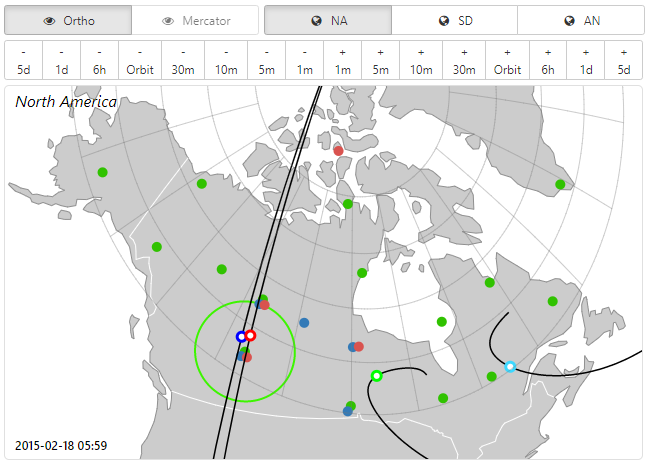
Swarm-Aurora is a web-based platform that facilitates the identification of opportunities for auroral research utilising Swarm data. Central to Swarm-Aurora is the Conjunction Browser which enables identification of conjunctions between Swarm satellites and auroral observations such as those made by All-Sky Imagers, Meridian Scanning Photometers, and Meridian Imaging Spectrographs. The web platform provides a simultaneous view of a map with station locations and the magnetic ground tracks of Swarm and other satellites, as well as summary auroral data (keograms) and some summary in situ data (e.g. field-aligned currents from Swarm).
An interesting capability is the identification of "triple conjunctions" between a Swarm spacecraft, a magnetospheric spacecraft (e.g. a THEMIS probe), and a working ground-based auroral instrument. The underlying database contains summary data and ephemeris, and the platform provides links to full-resolution data from participating ground-based projects.
Swarm-Aurora forms the kernel of a new Canada Foundation for Innovation (CFI) Cyber Infrastructure Project called AuroraX. With funding from CFI, Swarm DISC, the Province of Alberta, and the Canadian Space Agency, the Swarm-Aurora team is going to add significant increased capabilities to Swarm-Aurora. These will include machine learning for classification of large sets of auroral images, the ingestion of observations from citizen scientists, tools for planning citizen science campaigns that will be organised around Swarm overflights, and a database linking directly to every image in data sets of participating projects.
Access Swarm Aurora
Visit the Swarm-Aurora website